
The iPhone 17 Pro Max Surprises With An Unprecedented Image of the Moon’s Far Side
Commander Reid Wiseman amazed viewers during NASA’s livestream by showing an image of the Chebyshev crater. A photo shot taken with an iPhone 17 Pro Max from the Orion spacecraft during the Artemis II mission has captured the public’s attention. In a groundbreaking maneuver, Commander Reid Wiseman managed to photograph the Chebyshev crater — located on the Moon’s hidden side—using only his phone’s 8× zoom, without a tripod or any technical support.
Lunar photography: the iPhone 17 Pro Max documents the Moon’s far side
During Artemis II’s final approach to the lunar surface, Commander Reid Wiseman surprised viewers in NASA’s livestream by showing, live from the Orion capsule, an image of the Chebyshev crater taken with his iPhone 17 Pro Max.
To capture the photo, the crew had to switch off all cabin lights, eliminating reflections on the windows and enabling a clean, detailed shot of the lunar surface.
The process was simple but demanding: with the ship completely dark and under microgravity conditions, Wiseman aimed the iPhone at the Moon and took the shot using the 8× optical zoom—entirely handheld.
The result was a sharp, spectacular image of a crater 179 kilometers in diameter, a key reference in lunar maps and located in the hemisphere not visible from Earth.
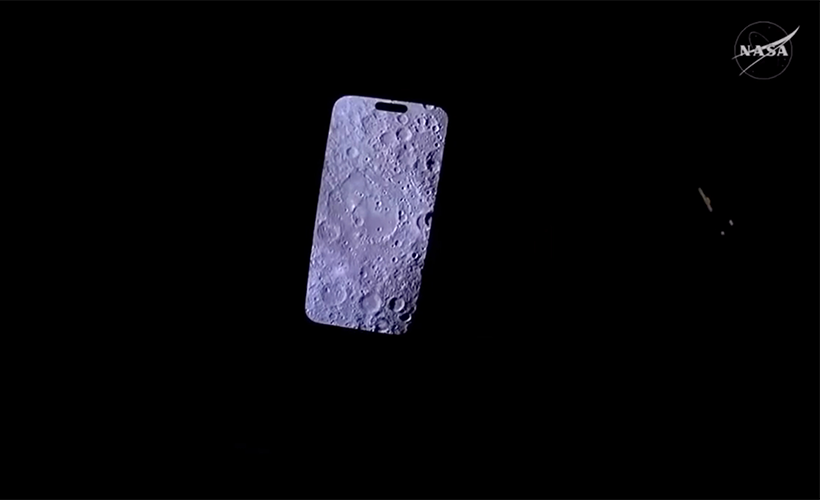
In a groundbreaking maneuver, Commander Reid Wiseman managed to photograph the Chebyshev crater — located on the Moon’s hidden side—using only his phone’s 8× zoom, without a tripod or any technical support. Image credit: NASA.
Mobile technology in space: the iPhone debuts on Artemis II
Artemis II marks a milestone by including, for the first time, four iPhone 17 Pro Max devices aboard a lunar mission, alongside professional cameras such as the Nikon D5, Nikon Z9, and GoPro HERO4.
Despite this specialized equipment, the iPhone photos have attracted the most interest. NASA has begun sharing some of these images on its official Flickr account, though Wiseman’s picture had not yet appeared there when this report was written.
The agency confirmed that the crew is already transmitting visual material from the lunar flyby back to Earth. Once the high‑resolution version is available, the range and quality achieved by the iPhone 17 Pro Max under extreme conditions—more than 400,000 kilometers away—are expected to be admired and analyzed.
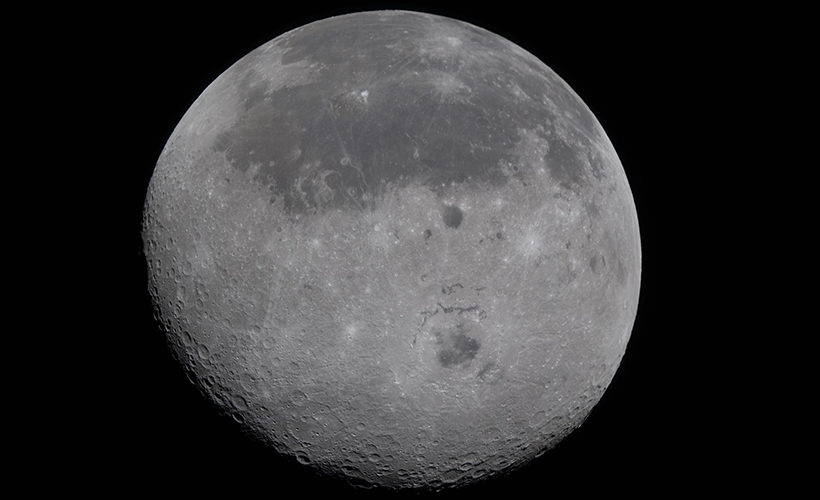
In this view of the Moon, the near side (the hemisphere we see from Earth), is visible at the top half of the Moon disk. It is identifiable by the dark splotches. These are ancient lava flows from a time early in the Moon’s history when it was volcanically active. Image Credit: NASA.
The Chebyshev Crater: a historic target from Orion
The Chebyshev crater, the subject of the photograph, was identified live by Mission Control. Its location on the Moon’s far side adds special value to the image, as that region is only visible during space missions.
As Artemis II orbited the satellite, Wiseman captured a unique perspective, demonstrating the potential of modern mobile technology in space exploration.
This mission not only expands the lunar photo archive but also shows how everyday devices, in astronauts’ hands, can document key scientific milestones with surprising results.
Artemis II revives “Earthrise”
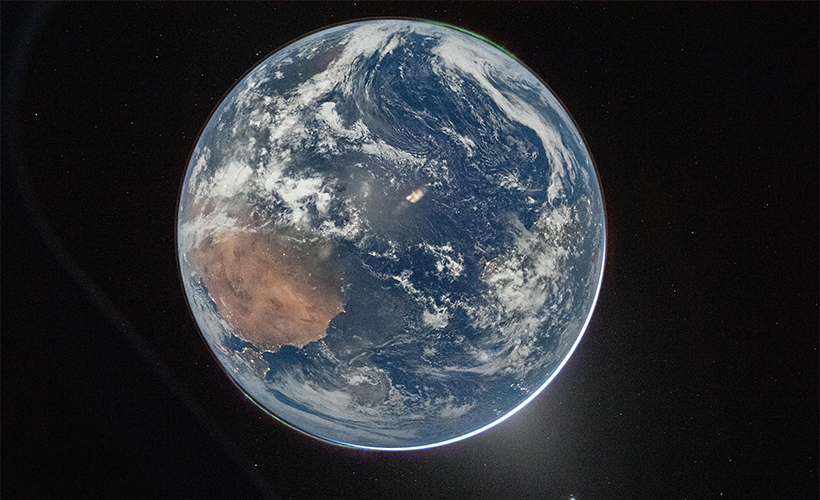
NASA recently released an image reminiscent of one of space exploration’s most symbolic moments: the “Earthrise.” On April 6, 2026, while orbiting the Moon, the Artemis II crew photographed the setting of Earth, evoking the famous shot by Bill Anders during Apollo 8 in 1968.
Back then, Anders—alongside Frank Borman and Jim Lovell—witnessed Earth appearing over the lunar horizon during the mission’s fourth orbit. The iconic image resulted from a rotation maneuver and the use of a color‑film Hasselblad camera, after Lovell supplied the correct film.
The photograph known as Earthrise was taken on December 24, 1968, and became a symbol of humanity’s ability to view our planet from another world.
According to NASA, the image captures the contrast between Earth’s night side and its illuminated hemisphere, with visible clouds over Australia and Oceania. The original film had to be brought back to Earth for development, posing an added technical challenge for Apollo 8.
During Artemis II, the astronauts experienced a similar situation, observing Earth’s setting and sunrise from lunar orbit using advanced digital technology.
They also managed to photograph the Mare Orientale, a ringed structure on the Moon’s surface that helps scientists study how massive impacts shape planetary bodies.
Links
- Artemis II Journey to the Moon – NASA
- Sell your pre-owned Apple iPhone online – iGotOffer
- Everything About Apple’s Products – The complete guide to all Apple consumer electronic products, including technical specifications, identifiers and other valuable information.
NASA’s Artemis II Crew Flies Around the Moon (Official Broadcast) [Video]
Video uploaded by NASA on April 6, 2026.





Facebook
Twitter
RSS